
10 Proven Digital Marketing Strategies to Grow Your Business in 2026
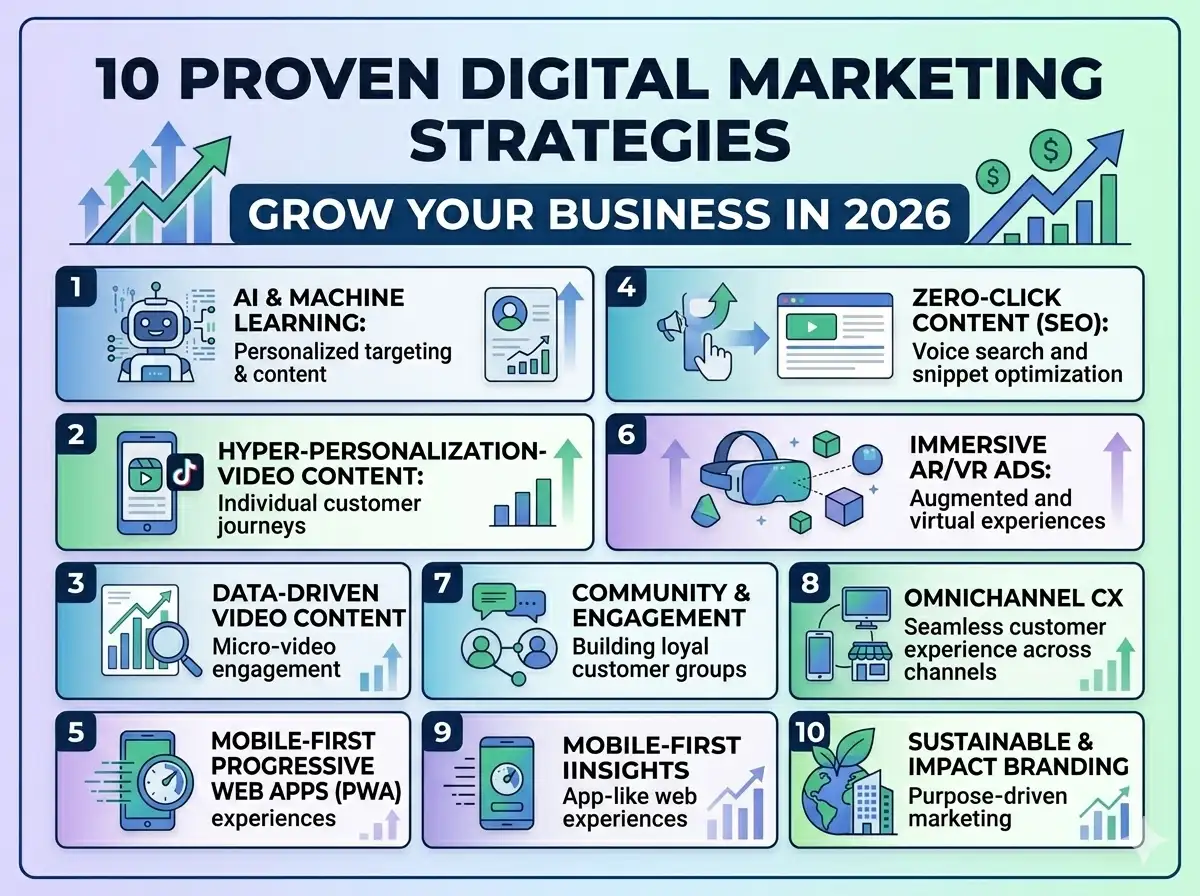
Digital marketing continues to evolve at a rapid pace, and businesses that fail to adapt often struggle to stay relevant. In 2026, success is no longer about simply being online—it’s about being strategic, data-driven, and customer-focused.
Whether you are a startup, a small business owner, or an established brand, the right digital marketing strategies can help you generate consistent leads, improve brand visibility, and drive sustainable growth.
This guide outlines 10 proven digital marketing strategies that are practical, effective, and aligned with current market trends.
1. Build a Strong Content Marketing Foundation
Content remains one of the most powerful tools in digital marketing. However, in 2026, generic content is no longer effective. Your content must be valuable, relevant, and problem-solving.
Focus on creating:
- In-depth blog posts
- Educational guides
- Case studies
- Video content
Instead of publishing frequently, prioritize quality over quantity. A well-researched article that genuinely helps your audience can outperform multiple low-quality posts.
Why it works:
Good content builds trust, improves SEO rankings, and positions your brand as an authority in your industry.
2. Invest in Search Engine Optimization (SEO)
SEO is a long-term strategy that ensures your business gets discovered organically on search engines like Google.
In 2026, SEO is not just about keywords—it includes:
- User experience
- Website speed
- Mobile optimization
- Search intent
Focus on:
- Targeting relevant keywords
- Optimizing on-page elements (titles, meta descriptions)
- Creating high-quality backlinks
Example:
A local business optimizing for “best digital marketing agency in Pune” can attract highly targeted traffic ready to convert.
Why it works:
SEO drives consistent, high-intent traffic without ongoing ad spend.
3. Leverage Social Media Marketing Strategically
Social media is no longer just for visibility—it’s a lead generation and relationship-building platform.
Instead of being present on every platform, focus on where your audience is most active.
Key approaches:
- Share educational and engaging posts
- Use short-form video content (Reels, Shorts)
- Interact with your audience regularly
- Use storytelling to connect emotionally
Pro tip:
Consistency matters more than perfection. A consistent posting schedule builds trust over time.
Why it works:
Social media helps humanize your brand and keeps you top-of-mind for your audience.
4. Use Paid Advertising for Faster Results
While organic strategies are important, paid advertising delivers immediate visibility and faster lead generation.
Popular platforms:
- Google Ads
- Facebook & Instagram Ads
- YouTube Ads
To succeed with paid ads:
- Define a clear objective (leads, sales, traffic)
- Target the right audience
- Use compelling creatives and copy
Example:
A service-based business can run lead generation ads offering a free consultation.
Why it works:
Paid ads allow precise targeting and scalable growth when optimized correctly.
5. Implement a High-Converting Sales Funnel
Driving traffic is only half the job—converting that traffic is what truly matters.
A structured sales funnel guides users through:
- Awareness
- Interest
- Decision
- Action
Key components:
- Landing pages
- Lead magnets
- Email nurturing
- Conversion-focused offers
Example:
Offer a free ebook → collect leads → nurture via email → convert through consultation.
Why it works:
A funnel ensures that potential customers are guided, educated, and converted systematically.
6. Focus on Email Marketing for Long-Term Engagement
Despite the rise of new platforms, email marketing remains one of the highest ROI channels.
Use email marketing to:
- Share valuable content
- Promote offers
- Nurture leads
- Retain existing customers
Best practices:
- Personalize emails
- Segment your audience
- Maintain consistency
Example:
Send a weekly newsletter with tips, case studies, and updates.
Why it works:
Email marketing builds direct communication with your audience without relying on algorithms.
7. Optimize Your Website for Conversions
Your website is your digital storefront. Even if you generate traffic, a poorly optimized website will result in lost opportunities.
Key elements of a high-performing website:
- Clear messaging
- Fast loading speed
- Mobile responsiveness
- Strong call-to-action (CTA)
Ask yourself:
- Is it easy to understand what your business offers?
- Can users take action quickly?
Why it works:
A well-optimized website increases conversion rates and improves user experience.
8. Use Video Marketing to Capture Attention
Video content continues to dominate digital platforms.
Types of videos to create:
- Educational videos
- Product/service demos
- Testimonials
- Behind-the-scenes content
Short-form videos (under 60 seconds) are particularly effective for engagement.
Example:
A digital marketing agency sharing quick tips on Instagram Reels.
Why it works:
Videos are more engaging and easier to consume compared to text.
9. Leverage Data and Analytics for Decision Making
In 2026, successful marketing is data-driven.
Track key metrics such as:
- Website traffic
- Conversion rates
- Cost per lead
- Customer acquisition cost
Use tools like:
- Google Analytics
- Meta Ads Manager
- CRM systems
Why it works:
Data helps you understand what’s working and what needs improvement, enabling smarter decisions.
10. Build Trust Through Social Proof and Branding
Trust plays a crucial role in purchasing decisions.
Strengthen your brand by showcasing:
- Customer testimonials
- Reviews
- Case studies
- Success stories
Consistency in branding (logo, colors, messaging) also builds recognition.
Example:
Displaying client results like:
“Increased leads by 200% in 3 months”
Why it works:
People trust other customers’ experiences more than direct advertising.
Bringing It All Together
While each strategy is powerful on its own, real growth happens when they work together.
For example:
- SEO drives traffic
- Content builds trust
- Social media engages users
- Funnels convert leads
- Email marketing nurtures relationships
A successful digital marketing approach is not about using one strategy—it’s about creating a connected system.
Common Mistakes to Avoid
Even with the right strategies, certain mistakes can limit your growth:
- Trying to do everything at once instead of focusing
- Ignoring your target audience
- Inconsistent marketing efforts
- Not tracking performance
- Prioritizing sales over value
Avoiding these pitfalls can significantly improve your results.
Final Thoughts
Digital marketing in 2026 is more dynamic, competitive, and opportunity-rich than ever before. Businesses that focus on value creation, consistency, and strategic execution will continue to grow.
Start by implementing a few strategies from this list, measure your results, and gradually expand your efforts.
Growth doesn’t come from random actions—it comes from structured, well-executed strategies backed by data and continuous improvement.
By staying adaptable and customer-focused, your business can not only survive but thrive in the evolving digital landscape.