Complete Guide to Building a High-Converting Sales Funnel (With Examples)
In today’s competitive digital landscape, attracting attention is no longer the biggest challenge—converting that attention into paying customers is. This is where a well-structured sales funnel becomes essential.
A sales funnel is not just a marketing concept; it’s a systematic journey that guides potential customers from their first interaction with your brand to making a purchase—and beyond.
This guide will walk you through what a high-converting sales funnel is, how to build one step-by-step, and real-world examples to help you apply these concepts effectively.
What is a Sales Funnel?
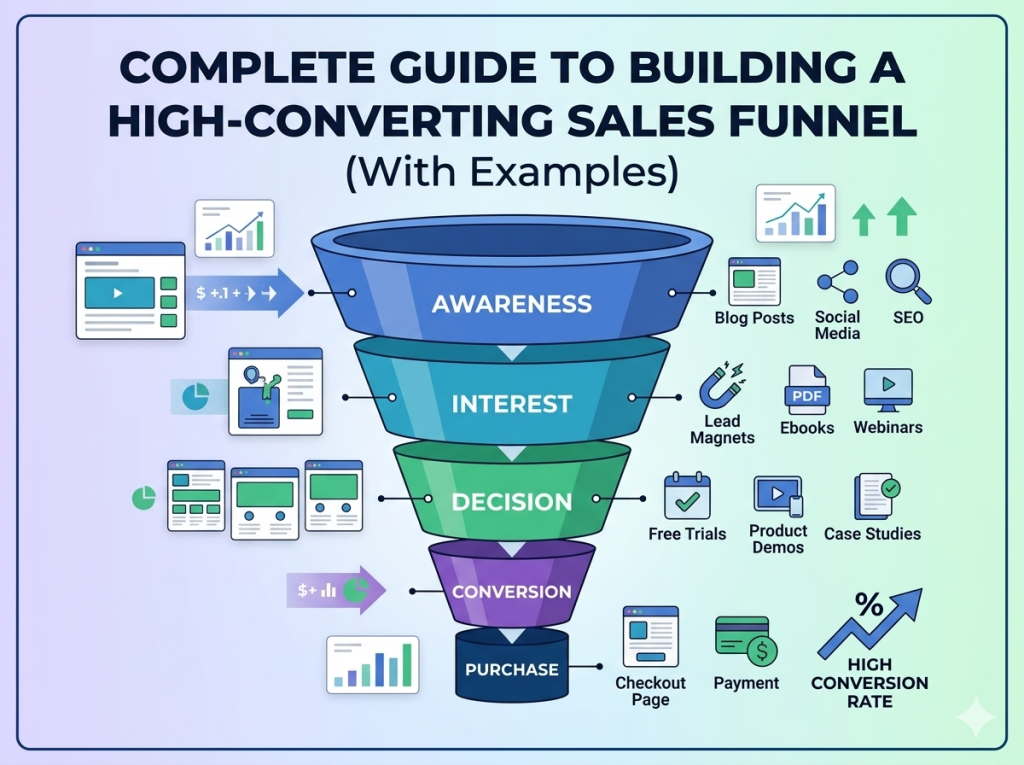
A sales funnel represents the journey a potential customer takes before making a purchase. It is called a “funnel” because you start with a large audience at the top, and gradually narrow it down to those who convert.
A typical sales funnel consists of four main stages:
- Awareness – The customer discovers your brand
- Interest – They show interest in your product/service
- Decision – They evaluate and consider buying
- Action – They make a purchase
A high-converting funnel ensures that maximum people move from one stage to the next smoothly.
Why a Sales Funnel is Important
Many businesses make the mistake of trying to sell immediately. However, customers rarely buy on first interaction.
A structured sales funnel helps you:
- Build trust with your audience
- Educate potential customers
- Address objections before selling
- Increase conversion rates
- Optimize marketing spend
In simple terms, instead of chasing customers, your funnel nurtures and converts them automatically.
Key Elements of a High-Converting Sales Funnel
Before building a funnel, it’s important to understand what makes it effective.
1. Clear Target Audience
You cannot sell to everyone. Define:
- Who your ideal customer is
- Their pain points
- Their goals
The more specific your audience, the better your conversions.
2. Strong Value Proposition
Why should someone choose you?
Your funnel should clearly communicate:
- What problem you solve
- What makes you different
- What results customers can expect
3. Compelling Offer
Your offer is the backbone of your funnel.
Examples:
- Free consultation
- Discounted service
- Free ebook or guide
- Trial/demo
A strong offer increases engagement and conversions significantly.
4. Consistent Messaging
Your messaging across ads, landing pages, and emails should be aligned.
If your ad promises “10x leads,” your landing page should reinforce that promise.
Step-by-Step Process to Build a High-Converting Sales Funnel
Let’s break down the process into actionable steps.
Step 1: Create Awareness (Top of Funnel)
This is where people discover your business.
Channels to use:
- Social Media Ads (Facebook, Instagram)
- Google Ads
- SEO & Blog Content
- YouTube Videos
Goal: Attract relevant traffic
Example:
A digital marketing agency runs Instagram ads targeting small business owners with the message:
“Struggling to get leads online? Learn how to generate consistent leads.”
Step 2: Capture Leads (Lead Generation)
Once people show interest, you need to capture their information.
Methods:
- Landing pages
- Lead magnets (free value)
- Forms or sign-ups
Popular Lead Magnets:
- Free ebook
- Checklist
- Webinar
- Free audit
Example:
Offer a free resource like:
“Download Free Guide: 7 Proven Strategies to Generate Leads Online”
User submits:
- Name
- Phone number
Now they become a lead.
Step 3: Nurture Leads (Build Trust)
Most leads are not ready to buy immediately.
This stage focuses on building trust through consistent communication.
Channels:
- Email marketing
- WhatsApp follow-ups
- Retargeting ads
Content to share:
- Educational content
- Case studies
- Testimonials
- Success stories
Example:
Send a series of emails:
- Day 1: Welcome + value content
- Day 3: Case study
- Day 5: Common mistakes
- Day 7: Offer introduction
Step 4: Convert Leads into Customers
Now comes the selling phase.
At this stage, your lead already:
- Knows your brand
- Trusts your expertise
- Understands your value
Conversion strategies:
- Limited-time offers
- Free consultation calls
- Discounts
- Demo sessions
Example:
“Book a Free 30-Minute Consultation to Grow Your Business”
Step 5: Retain and Upsell (Post-Purchase)
A successful funnel doesn’t end with a sale.
Focus on:
- Customer retention
- Repeat purchases
- Upselling
Methods:
- Email follow-ups
- Loyalty programs
- Additional services
Example:
After delivering service:
“Upgrade to our premium plan for advanced growth strategies”
Real-World Sales Funnel Examples
Let’s look at practical examples to understand how funnels work.
Example 1: Digital Marketing Agency Funnel
Step 1: Awareness
Facebook ad:
“Get 50+ leads per month using proven marketing strategies”
Step 2: Lead Capture
Landing page offering:
“Free Marketing Audit”
Step 3: Nurture
- Email series explaining strategies
- Case studies of past clients
Step 4: Conversion
Call booking:
“Schedule your free consultation”
Step 5: Closing
Sales call → Service package sold
Example 2: E-commerce Funnel
Step 1: Awareness
Instagram ad showcasing product
Step 2: Interest
User visits product page
Step 3: Nurture
Retargeting ads:
“Still thinking? Get 10% off today”
Step 4: Conversion
User purchases product
Step 5: Retention
Email:
“Buy again and get exclusive discount”
Example 3: Online Course Funnel
Step 1: Awareness
YouTube video on a topic
Step 2: Lead Capture
Free webinar registration
Step 3: Nurture
Email reminders + valuable insights
Step 4: Conversion
Offer course at discounted price
Step 5: Upsell
Advanced course or mentorship
Common Mistakes to Avoid
Even well-designed funnels can fail if these mistakes are made:
1. Targeting the Wrong Audience
If your audience is not relevant, conversions will always be low.
2. Weak Landing Page
A confusing or unattractive landing page reduces trust and conversions.
3. No Follow-Up
Most businesses lose leads because they don’t follow up consistently.
4. Too Much Selling
If you push sales without providing value, users lose interest.
5. Ignoring Data
Always track:
- Conversion rate
- Cost per lead
- Drop-off points
Use data to improve your funnel continuously.
Tools to Build a Sales Funnel
You don’t need complex systems to get started.
Basic tools:
- Landing Pages: WordPress, ClickFunnels, Leadpages
- Email Marketing: Mailchimp, ConvertKit
- Ads: Facebook Ads, Google Ads
- CRM: HubSpot, Zoho
Start simple and scale as your business grows.
How to Optimize Your Funnel for Better Conversions
Building a funnel is just the beginning. Optimization is where real growth happens.
1. A/B Testing
Test:
- Headlines
- Ad creatives
- Call-to-action buttons
2. Improve User Experience
Ensure:
- Fast loading pages
- Mobile-friendly design
- Clear navigation
3. Strengthen Your Offer
A strong offer can outperform even average marketing.
4. Use Social Proof
Add:
- Testimonials
- Reviews
- Case studies
These increase trust significantly.
5. Retargeting
Most users don’t convert on first visit.
Use retargeting ads to bring them back.
Final Thoughts
A high-converting sales funnel is not built overnight—but once set up correctly, it becomes one of the most powerful assets for your business.
It allows you to:
- Attract the right audience
- Build trust systematically
- Convert leads efficiently
- Scale your business predictably
The key is to focus on providing value at every stage, rather than just selling.
Start simple, test continuously, and refine your approach based on data.
Over time, your funnel will not just generate leads—it will consistently generate qualified customers and long-term business growth.